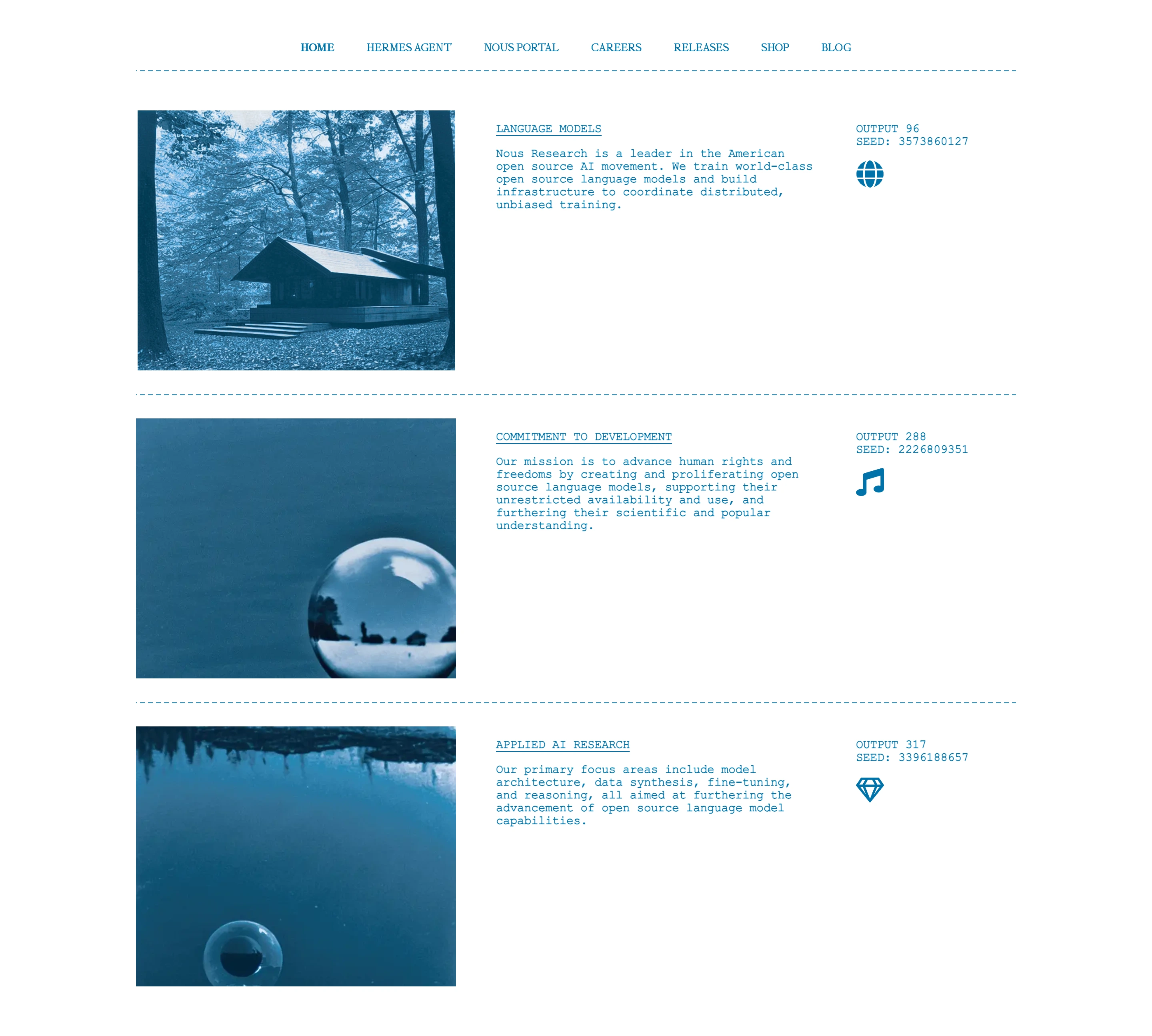
A cyan duotone photo essay run like a lab notebook — every image stamped OUTPUT nn / SEED: nnnnnnnnn as if it were a generation rather than a photograph. Uppercase monospace and dashed rules turn a company's about page into a specimen index.
Quiet, elemental, almost devotional toward nature and water — an AI research lab presenting itself as a field journal instead of a product. Calmer and less mythic than its Hermes Agent sibling page; the register here is naturalist, not occult.
Colors
One cyan-teal ink (a deep marine blue-green, distinct from Hermes' ultramarine) over paper white, with a full tonal range between the two. No accent hue, no grey, nothing else.
Type
Uppercase monospace end to end — nav, section headers, body copy, and the meta stamp all sit in the same small, tracked mono. There is no display face and no serif anywhere on the page; underlines are the only thing marking a header ('LANGUAGE MODELS').
Layout
A single nav row up top, then a repeating three-column row: a full-bleed square duotone photograph on the left, a short underlined headline plus a short paragraph in the middle, and a right-hand meta column stamping 'OUTPUT nn' and 'SEED: nnnnnnnnn' beside a tiny line-art glyph (a wireframe globe, a music note, a gem). Dashed horizontal rules separate every row, including the one under the nav.
Motion
None visible — the page reads as a static, printed index, consistent with the family's stillness-as-seriousness move.
Texture
Smooth duotone tone-mapping, not a screened halftone — full gradation from ink to paper with no visible dot pattern under zoom. The 'texture' is tonal, not mechanical.
Imagery
Quiet, elemental photography — a forest cabin, a glass orb reflecting a lake, an orb submerged underwater — run through a smooth duotone tone-map from paper white to one deep cyan-teal ink. This is a full tonal gradient, not a hard dither: no visible dot grid, closer to a toned photograph (a cyanotype print) than a screened halftone. Source or generate real-feeling nature/still-life photography in this quiet register, then apply the duotone curve as a real 2-colour gradient map (Photoshop duotone, or an actual LUT) rather than a CSS sepia/hue-rotate filter, so the midtones hold together instead of banding. Tool: kie-ai or nanobanana for the source photography, then a proper duotone pass after.
Don't
Don't drop to a hard ordered dither or 1-bit threshold — that's the Hermes Agent page's move, not this one; keep the gradient smooth and photographic. Don't introduce a second typeface or a display serif; this page runs on exactly one face at one register.
Make it your own
Turn this reference into a useful brief for your project. Copy it into the AI tool you already use.
Add constraintsPreview & edit promptAssembled in your browser. No API key or AI request needed. Changing the fields refreshes the preview.