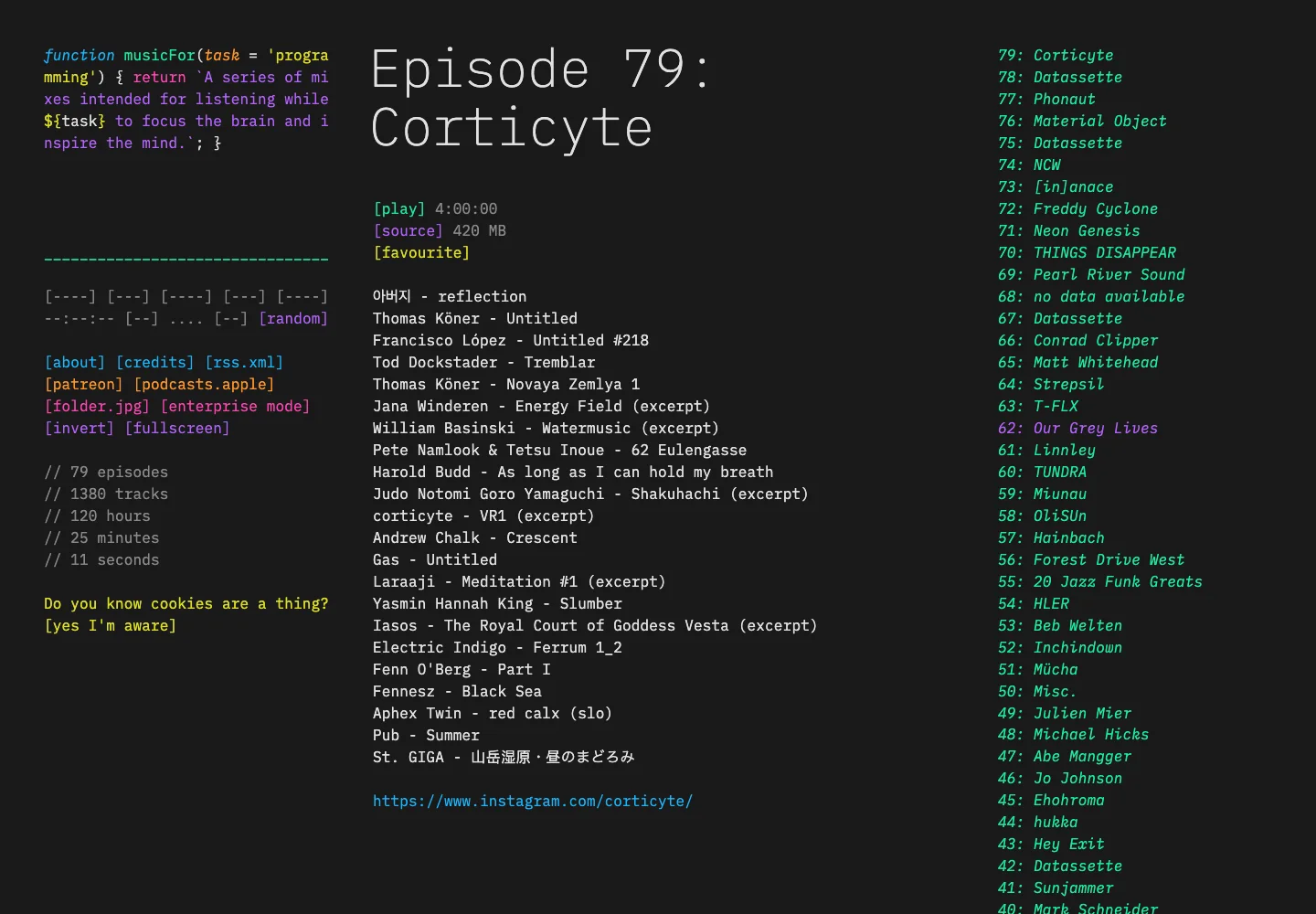
Keep the current item and the wider archive visible without turning the archive into large cards.
Design notes
Surface
Listening workspace
Navigation
Episode links form a persistent right-side list while playback controls stay beside the current episode.
Layout
A broad episode column with credits and controls sits between supporting context and a narrow numbered archive.
Density
Primary content has the most space; repeated rows and secondary navigation use a compact, consistent rhythm.
Color
Black background, gray monospaced text, and syntax-like green and violet accents.
Type
Use consistent monospaced spacing and clear column widths to organize dense credits and lists.
Pattern
Keep the current item and the wider archive visible without turning the archive into large cards.
States
Public episode page in its unplayed state; no audio was started.
Don't
Adapt the interaction pattern to your own product. Do not copy brand assets, sample identities, proprietary text, or assume unseen states. Specify keyboard behavior, loading, empty, error, and narrow-screen layouts for your implementation.
Make it your own
Turn this reference into a useful brief for your project. Copy it into the AI tool you already use.
Add constraintsPreview & edit promptAssembled in your browser. No API key or AI request needed. Changing the fields refreshes the preview.